Ninety-seven percent of the world’s total commercial tuna catch now comes from stocks at “healthy” abundance levels, according to the January 2026 International Seafood Sustainability Foundation (ISSF) Status of the Stocks report. This increase is a ten-percentage-point increase from the previous March 2025 report. At the same time, nearly 100% of the global tuna catch comes from stocks not experiencing overfishing, indicating that tuna fisheries are not only biologically healthy but also being harvested at sustainable levels. Both figures represent the highest levels ever reported by ISSF.
“These results did not happen by chance. They reflect many years of sustained investment in science-based fisheries management — including improved data, stock assessments methods, and management frameworks — the adoption of harvest strategies, and stronger oversight by tuna regional fisheries management organizations,” said Victor Restrepo, ISSF Vice President of Science and Chair of the ISSF Scientific Advisory Committee. “When ISSF began reporting these metrics in 2011, only 70% of the global tuna catch came from stocks at healthy abundance levels, and just 71% came from stocks not experiencing overfishing. The progress we see today is the result of long-term, coordinated efforts.”
Several stocks showed measurable progress in abundance or spawning biomass (SSB):
- Atlantic Ocean bigeye: improved from yellow to green
- Indian Ocean bigeye: improved from orange to yellow
- Pacific Ocean bluefin: improved from orange to yellow
- Indian Ocean yellowfin: improved from yellow to green
The change in exploitation rate or fishing mortality (F) is limited to Indian Ocean bigeye, improving from orange to green.
ISSF publishes its signature Status of the Stocks report several times yearly using the most current scientific data on 23 major commercial tuna stocks. Related infographics for the January 2026 report are available here and here.
Key Statistics in the New Status of the Stocks Report
- Abundance or SSB levels: Globally, 74% of the 23 stocks are at a healthy level of abundance — up nine percentage points since the March 2025 report. No stocks are overfished, and 26% remain at intermediate levels.
- Fishing mortality levels: Ninety-six percent of the 23 stocks are not experiencing overfishing — an improvement of five percentage points from the March 2025 report. None are experiencing overfishing and about 4% are at an intermediate level — unchanged since March 2025.
- Harvest strategies: About 52% of the global tuna catch now comes from stocks with adopted Harvest Strategies (Management Procedures). Key RFMO actions since the previous report include the Western and Central Pacific Fisheries Commission adopting a management procedure and harvest control rule for South Pacific albacore, and the International Commission for the Conservation of Atlantic Tunas adopting a management procedure and harvest control rule for Western Atlantic skipjack.
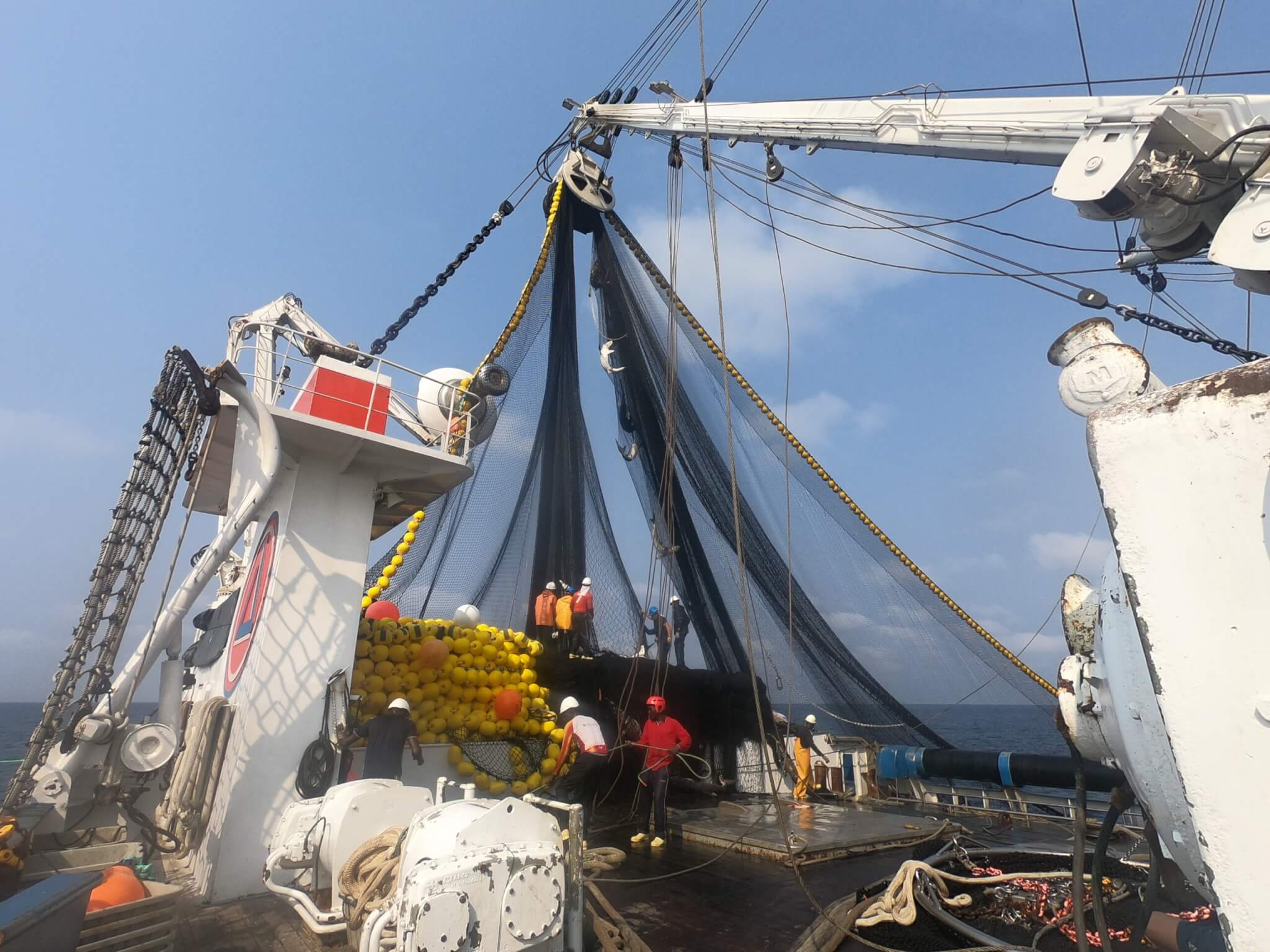
- Tuna production by fishing gear: Sixty-six percent of the catch is made by purse seining, followed by longline (9%), pole-and-line (7%), gillnets (3%) and miscellaneous gears (15%).
- Tuna production by species: Fifty-eight percent of the catch corresponds to skipjack tuna, followed by yellowfin (30%), bigeye (7%), and albacore (4%). Bluefin tunas account for 1% of the global catch.
- Largest tuna catches by stock: The five largest catches in tonnes — all unchanged since the previous report — are Western Pacific Ocean skipjack, Western Pacific Ocean yellowfin, Eastern Pacific Ocean skipjack, Indian Ocean skipjack, and Indian Ocean yellowfin.
- Total catch: The global catch of albacore, bigeye, bluefin, skipjack, and yellowfin was 5.8 million tonnes in 2024, an 11% increase from 2023 levels.
The Status of the Stocks report is reviewed by the ISSF Scientific Advisory Committee (SAC), which provides advice on its content and ratings, following the agreed ISSF methodology. The report does not advocate any particular seafood purchase decisions.
About the Status of the Stocks Report
There are 23 stocks of major commercial tuna species worldwide — six albacore, four bigeye, four bluefin, five skipjack, and four yellowfin stocks. The Status of the Stocks summarizes the results of recent scientific assessments of these stocks and the current management measures adopted by the RFMOs, as of January 2026.
The Status of the Stocks presents a comprehensive analysis of tuna stocks by species. The Evaluation of the Sustainability of Global Tuna Stocks Relative to MS Criteria provides scores for the stocks and RFMOs based on Marine Stewardship Council assessment criteria. Together, these tools help define the continuous improvement achieved and the areas and issues that require more attention.
In addition, ISSF maintains a data visualization tool based on its Status of the Stocks report. The “Interactive Stock Status Tool” is located on the ISSF website and accessible through the Status of the Stocks overview page. Users can easily toggle through tuna abundance and exploitation health indicators by catch or stock, filter by location and species, and see the share of total catch by species/stocks and gear types.